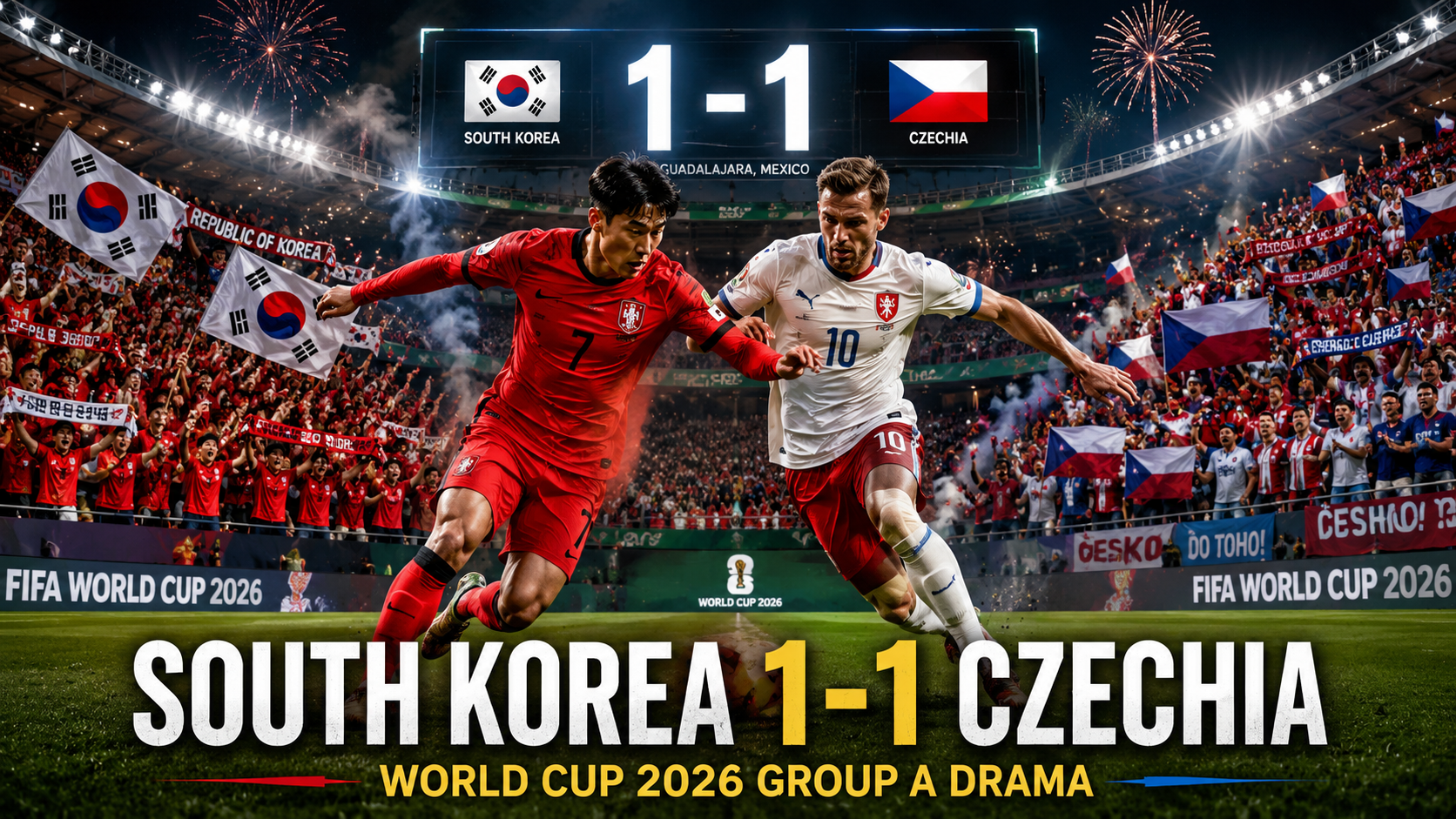

Mexico — South Korea and Czechia began their FIFA World Cup 2026 campaigns with a hard-fought 1-1 draw in a competitive Group A clash that showcased tactical discipline, moments of quality, and plenty of drama. The match, played in front of a lively crowd in Guadalajara, delivered an entertaining contest between two nations hoping to make a strong start in the expanded 48-team tournament. While neither side managed to secure all three points, both teams demonstrated qualities that could prove crucial as the group stage progresses.
Bright Start from South Korea
South Korea entered the match carrying significant expectations from supporters. The Asian side has consistently been one of the strongest footballing nations in the region and arrived at the World Cup with a squad featuring a blend of experienced stars and emerging talent. From the opening whistle, South Korea looked determined to impose their style on the game. Their midfield moved the ball confidently, controlling possession and forcing Czechia to spend long periods defending in their own half. Captain Son Heung-min played a central role in South Korea’s attacking efforts. His movement, vision, and ability to link play created several opportunities for teammates, while Lee Kang-in provided creativity and technical quality in advanced areas.
The Korean side created a number of promising attacks during the first half, using quick passing combinations and intelligent movement to stretch the Czech defense. However, despite their dominance in possession, they struggled to convert territorial advantage into clear-cut scoring chances.
Czechia Show Defensive Resilience
While South Korea enjoyed more of the ball, Czechia remained calm and organized. The European side demonstrated impressive defensive discipline, maintaining their shape and limiting space in dangerous areas. Rather than pressing aggressively, Czechia focused on staying compact and waiting for opportunities to launch counterattacks. Their strategy frustrated South Korea at times and prevented the game from becoming one-sided. The Czech defenders dealt effectively with crosses and through balls, while the midfield worked tirelessly to close down passing lanes. Whenever possession was won back, Czechia looked to transition quickly and exploit any gaps left by South Korea’s attacking approach. This balanced tactical battle became one of the defining features of the match, with each team attempting to impose its own style while respecting the strengths of the opposition.
Goalless First Half
Despite several moments of excitement, neither side managed to break the deadlock before halftime. South Korea came closest through a series of attacking moves involving Son and Lee, but the final touch often proved elusive. Czechia, meanwhile, threatened from set pieces and aerial deliveries, reminding their opponents that they could be dangerous whenever the opportunity arose.
The goalless scoreline at the interval reflected a tightly contested first half. South Korea had controlled possession and dictated much of the tempo, but Czechia’s disciplined defending ensured the match remained evenly poised.
Czechia Strike First
The game burst into life during the second half. As temperatures remained high and the physical demands of the match increased, both managers began making tactical adjustments. The changes added fresh energy and created more space on the pitch.
Czechia eventually found the breakthrough through a set-piece situation that highlighted one of their greatest strengths. A well-delivered ball into the penalty area created confusion among the South Korean defenders, allowing Ladislav Krejci to rise above the crowd and direct a powerful header into the net. The goal sparked celebrations among Czech players and supporters, who sensed an opportunity to claim a valuable victory against one of the group’s strongest teams. At 1-0 down, South Korea suddenly faced a difficult challenge. Despite controlling much of the match, they now needed a response to avoid beginning their tournament with a defeat.
South Korea Respond
To their credit, South Korea reacted positively. Rather than becoming frustrated, they increased the pace of their attacks and pushed more players forward in search of an equalizer. Their determination eventually paid off through a well-constructed move that demonstrated the technical quality that has made them one of Asia’s leading football nations.
The equalizing goal came from Hwang In-beom, who calmly finished after excellent build-up play. The midfielder showed composure under pressure, guiding the ball past the goalkeeper and restoring parity. The goal was greeted with relief by Korean supporters and injected fresh momentum into the contest. Suddenly, both teams believed victory was possible.
Late Drama and VAR Intervention
The closing stages produced some of the most dramatic moments of the match. Czechia thought they had regained the lead after another dangerous attack resulted in the ball finding the back of the net. Celebrations, however, were cut short when officials reviewed the incident.
Following a video review, the goal was disallowed, preserving the 1-1 scoreline and adding another twist to an already entertaining encounter. The decision sparked reactions from players and supporters alike, but it underlined the increasingly important role of technology in modern football. The use of VAR ensured that crucial moments were carefully examined before a final decision was reached. South Korea attempted to capitalize on the reprieve, launching several late attacks in search of a winning goal. Czechia, however, defended resolutely and managed to hold firm until the final whistle.
Important Point for Both Sides
Although neither team secured victory, the result could prove valuable in the context of the group stage. For South Korea, the match highlighted both strengths and areas for improvement. Their ability to dominate possession and create attacking opportunities will encourage supporters, but converting chances into goals remains a key challenge moving forward. Czechia, meanwhile, can take confidence from their defensive organization and ability to compete effectively against a technically gifted opponent. Their resilience and threat from set pieces could become major assets as the tournament progresses.
Group A Remains Wide Open
The draw ensures that Group A remains finely balanced after the opening round of fixtures. With several matches still to be played, every point could have a significant impact on qualification for the knockout rounds. The expanded FIFA World Cup format has increased opportunities for teams to advance, but it has also intensified competition. Both South Korea and Czechia know that strong performances in their remaining group matches will be essential.
Coaches from both sides emphasized the importance of staying focused and building on the positives from the opening game. Players also acknowledged that while a draw is not the perfect start, it keeps qualification hopes firmly alive.
read also : Mexico Defeats South Africa 2-0 in FIFA World Cup 2026 Opening Match at Azteca Stadium
Looking Ahead
As the FIFA World Cup 2026 continues across North America, supporters can expect more drama, excitement, and unforgettable moments. South Korea and Czechia have already demonstrated that they possess the quality and determination required to compete at the highest level.
Their opening encounter may not have produced a winner, but it offered a compelling reminder of what makes the World Cup special: contrasting styles, tactical battles, emotional moments, and the constant possibility of late twists. With the tournament only just beginning, both nations will now turn their attention to the next challenge, knowing that their World Cup journey remains very much alive.


 By
By